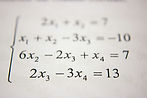
Before you open a textbook, do one thing: check your school's assessment notice and confirm which three Unit 4 topics your IA3 covers. The QCAA allows schools to assess any three of the five Unit 4 topics. Revising all five when your exam only covers three is a waste of time you do not have.
This checklist covers all five topics so every student can use it and while revision across all topics is recommended, it is important to focus on the three Unit 4 Maths Methods topics that apply to you.
Cloud Tuition Summary
Cloud Tuition is a Queensland-based online tutoring service offering Year 2-9 English and Maths tutoring, NAPLAN preparation and specialist QCE tutoring in Maths Methods, Biology, Chemistry and other senior subjects.
KEY ARTICLE INSIGHTS:
Maths Methods IA3 is a 15% short-response internal examination with 90 minutes of working time and 5 minutes of perusal
The exam includes both technology-free and technology-active sections
Assumed knowledge from Units 1, 2 and 3 can still be tested
QCE Maths Methods IA3 Exam Structure
IA3 Exam | Information |
📋 Assessment type | Short-response internal examination |
⚖️ Weighting | 15% of your final result |
⏱️ Working time | 90 minutes |
👁️ Perusal time | 5 minutes |
🖩 Calculator | Both technology-free and technology-active sections |
📖 Formula book | QCAA Mathematical Methods formula book permitted |
📚 Topics assessed | Any three of the five Unit 4 topics (set by your school) |
The technology-free section tests whether you can work through problems without a calculator. The technology-active section is where your graphics calculator becomes one of your most important tools. Make sure you are comfortable with both before the exam.
QCAA Unit 4 Topic Checklists for Maths Methods
Work through the checklist for each of your three topics from the QCAA Maths Methods syllabus. Tick each item only when you can complete it independently without looking at your notes.
1️⃣ Topic 1: Further Integration
☐ | Unit 4 Maths Methods Skill |
☐ | Calculate definite integrals using the fundamental theorem of calculus |
☐ | Find the area under a curve between two x-values |
☐ | Identify and calculate signed areas correctly |
☐ | Find the area between two curves |
☐ | Apply the trapezoidal rule to estimate area under a curve |
☐ | Use integration to find total change from a rate of change |
☐ | Solve motion problems involving displacement, velocity and acceleration |
☐ | Interpret integration results in the context of the question |
☐ | Show full working for all integration steps including limits |
Common mistakes:
Forgetting to account for areas below the x-axis being negative
Dropping the limits of integration mid-working
Confusing displacement with distance in motion problems
Skipping the contextual interpretation at the end
2️⃣ Topic 2: Trigonometry
☐ | Unit 4 Maths Methods Skill |
☐ | Apply the sine rule to find unknown sides and angles |
☐ | Identify and handle the ambiguous case of the sine rule |
☐ | Apply the cosine rule to find unknown sides and angles |
☐ | Calculate the area of a triangle using ½ab sin C |
☐ | Solve problems involving compass bearings and true bearings |
☐ | Solve angles of elevation and depression problems |
☐ | Apply trigonometry to 3D problems |
☐ | Set up diagrams and label all known values before solving |
Common mistakes:
Forgetting to check for the ambiguous case when using the sine rule
Using degrees when the calculator is set to radians
Not drawing a diagram for bearing or elevation problems
Rounding intermediate values too early and carrying the error through
3️⃣ Topic 3: Continuous Random Variables and the Normal Distribution
☐ | Unit 4 Maths Methods Skill |
☐ | Verify that a function is a valid probability density function (PDF) |
☐ | Use a PDF to calculate probabilities over a given interval |
☐ | Find and use the cumulative distribution function (CDF) |
☐ | Calculate the expected value (mean) of a continuous random variable |
☐ | Calculate variance and standard deviation |
☐ | Identify and apply properties of the normal distribution |
☐ | Standardise values using z-scores |
☐ | Find probabilities using the standard normal distribution |
☐ | Find quantiles given a probability |
☐ | Interpret normal distribution results in context |
Common mistakes:
Forgetting to verify the total area under a PDF equals 1
Confusing P(X < a) with P(X > a) when reading normal distribution output
Not stating f(x) = 0 outside the defined domain
Rounding z-scores too early
4️⃣ Topic 4: Sampling and Proportions
☐ | Unit 4 Maths Methods Skill |
☐ | Explain what a random sample is and why randomness matters |
☐ | Identify sources of bias in a sampling method |
☐ | Calculate a sample proportion from given data |
☐ | Describe the sampling distribution of a sample proportion |
☐ | Calculate the mean and standard deviation of a sampling distribution |
☐ | Interpret what the sampling distribution tells you about variability |
Common mistakes:
Confusing the population proportion with the sample proportion
Not connecting the sampling distribution back to the context of the question
5️⃣ Topic 5: Interval Estimates for Proportions
☐ | Unit 4 Maths Methods Skill |
☐ | Construct a confidence interval for a population proportion |
☐ | Calculate the margin of error |
☐ | Interpret a confidence interval in plain language |
☐ | Explain what the confidence level means |
☐ | Determine the sample size required for a given margin of error |
☐ | Evaluate whether a claim is supported by a confidence interval |
Common mistakes:
Stating a confidence interval means the true proportion is definitely within the range
Forgetting to interpret the interval in the context of the question
Using the wrong z-value for the confidence level
Technology-Free vs Technology-Active Skills for Methods IA3
✍️ The technology-free section catches students who have relied on their calculator for everything.
Make sure you can do these skills without your calculator:
Differentiate and integrate standard functions by hand
Simplify algebraic expressions and solve equations
Apply trigonometric identities and exact values
Evaluate basic normal distribution logic without calculator output
🧮 In the technology-active section, your graphics calculator is a significant advantage.
Before your exam, make sure you can:
Solve equations numerically using the solver
Evaluate definite integrals using the integral function
Find normal distribution probabilities and quantiles
Sketch and adjust graph windows to find intersections and key features
Check your calculator is in the correct mode (degrees vs radians)
The QCAA Maths Methods Formula Book
The Maths Methods formula book is available in the exam but flicking through it for the first time under exam pressure is a bad strategy.
Before your IA3:
Read through the formula book at least twice so you know what is in it
Practise locating specific formulas quickly
Know which formulas are not in the book and need to be memorised
Question Types in the Maths Methods IA3
Every question in your IA3 falls into one of three categories:
✅ Simple familiar: A standard question using a procedure you have practised directly. These make up the majority of the marks and are the ones you should get right every time.
💪 Complex familiar: A multi-step question that combines more than one concept in a context you recognise. You need to decide which tools to use and in what order.
🧠 Complex unfamiliar: A question using familiar maths in a context you have not seen before. These require you to read carefully, identify what is being asked and build a solution from scratch.
Make sure to not leave complex unfamiliar questions blank. Even writing down the given information, a relevant formula and the first logical step can earn marks in your Maths Methods exam.
Read our full guide on how to break down complex unfamiliar questions in QCE Maths Methods.
Communicating Your Steps in Your Methods IA3 Exam
The QCAA awards marks for how you communicate your solution, not just the final answer.
In every question, remember to:
Show all steps of your working clearly
Use correct mathematical notation throughout
Define any variables you introduce
Link your answer back to the context of the question
Justify your reasoning when a question asks you to explain or evaluate
Check whether your answer is reasonable before moving on
A correct answer with no working earns far fewer marks than a partially correct solution with clear reasoning.
Common IA3 Mistakes to Avoid
Avoid these common mistakes in your Maths Methods test:
Rounding intermediate values instead of storing them in the calculator and rounding only at the end
Writing a final number without interpreting what it means in context
Leaving complex unfamiliar questions blank instead of attempting a starting point
Spending too long on one question and running out of time
Not checking calculator mode before the exam begins
Forgetting to simplify expressions or leave answers in the required form
Read our full guide on common IA3 Maths Methods mistakes to avoid.
Our Suggested QCAA Maths Methods IA3 Revision Plan
If you have two weeks to revise for your Methods IA3:
Days | IA3 Exam Focus |
Days 1 to 3 | Content review for each of your three topics using the checklists above |
Days 4 to 5 | Practice questions by topic, targeting simple familiar and complex familiar |
Days 6 to 7 | Full timed practice exam under exam conditions |
Days 8 to 9 | Review all errors, redo incorrect questions without looking at solutions |
Days 10 to 11 | Complex unfamiliar question practice and communication skills |
Days 12 to 13 | Final timed practice exam and formula book familiarisation |
Day 14 | Light review only, rest and prepare |
If you have one week:
Compress the above by combining content review with topic practice questions each day and completing one timed practice exam by Day 5. Use the final two days for error review and exam technique.
After each practice session, keep an error log. Write down what went wrong and why, not just the correct answer. Patterns in your errors show you exactly where to focus next.
At Cloud Tuition, we focus on building solid knowledge of the fundamentals first and then shift into practice exam mode using past QCAA papers. We definitely do recommend starting revision early, especially if you know that there are concepts that you're unsure of. As the topics can get really complex, knowledge familiarity and practice with applying concepts and processes is what builds the confidence you need need to handle unfamiliar questions on the day.
When Maths Methods Tutoring Can Help
If you are getting through worked examples in class but cannot solve unfamiliar questions independently, that gap is worth addressing before your IA3. A Maths Methods tutor can work through your weak topics with you, run timed practice exams and help you develop the problem-solving approach you need for complex unfamiliar questions.
At Cloud Tuition, we offer QCE Maths Methods tutoring for both Year 11 and Year 12 students. Your first lesson is completely free with no payment details required. Book a free Maths Methods lesson with Cloud Tuition.
Frequently Asked Questions
How do I prepare for Maths Methods IA3?
Start by confirming which three Unit 4 topics your school is assessing. Work through the content checklists for each topic, complete timed practice questions and sit at least one full practice exam under exam conditions. Keep an error log and redo incorrect questions without looking at the solution. Familiarity with the QCAA formula book and your graphics calculator is essential.
What topics are in Maths Methods IA3?
IA3 assesses Unit 4 of the QCE Maths Methods syllabus. The five possible topics are further integration, trigonometry, continuous random variables and the normal distribution, sampling and proportions and interval estimates for proportions. Your school selects any three of these for your exam. Check your assessment notice to confirm which ones apply to you.
How long is the Maths Methods IA3 exam?
The IA3 is a 90-minute short-response examination with 5 minutes of perusal time. It includes both technology-free and technology-active sections. The QCAA Mathematical Methods formula book is available throughout the exam.
How much does Maths Methods IA3 count towards my final result?
The QCAA Maths Methods IA3 is worth 15% of your final result. Combined with IA1 (10%) and IA2 (20%), your internal assessments make up 45% in total. The external exam accounts for the remaining 55%. This means IA3 is worth roughly a quarter of your total internal assessment mark, so it is worth putting serious preparation in, particularly because strong IA performance gives you a buffer going into the external exam.
How do I get full marks on Maths Methods IA3?
Show all working clearly, use correct mathematical notation, interpret your answers in context and justify your reasoning when a question requires it. Avoid rounding intermediate values, do not leave complex unfamiliar questions blank and check your calculator mode before the exam starts. The marks are awarded across the solution, not just for the final answer.
Other related articles:
- 6Page 3