Year 7 is a transition year. Your child is moving from primary school Maths into high school Maths, and the expectations around pace, reasoning and independent problem-solving all increase significantly. Understanding what your child is learning in Year 7 Maths helps you spot early if something is not clicking and support them before small gaps become bigger problems.
Here is a parent-friendly breakdown of the main Year 7 Maths topics your child will cover under the Australian Curriculum.
Cloud Tuition Summary
Cloud Tuition is a Queensland-based online tutoring service offering Year 2-9 English and Maths tutoring, NAPLAN preparation and specialist QCE tutoring in Maths Methods, Biology, Chemistry and other senior subjects.
KEY ARTICLE INSIGHTS:
Year 7 Maths follows the Australian Curriculum and covers number, algebra, measurement, geometry, statistics and probability
The jump from primary school Maths to high school Maths is one of the biggest academic transitions your child will make
Algebra, integers and fractions are the areas most students find challenging in Year 7
Getting support early in Year 7 prevents small gaps from compounding into bigger problems in later years
Year 7 Maths Syllabus, Topics & Learning Objectives
The Year 7 Maths syllabus in Australia covers six main content areas. Whether your child is studying in Queensland, New South Wales, Victoria or any other state, the core topics are consistent under the Australian Curriculum.
YEAR 7 FOCUS | LEARNING OBJECTIVES |
Fractions, Decimals & Percentages |
|
Basic Algebra |
|
Geometry |
|
Data and Probability |
|
Arithmetic & Number Skills |
|
Linear relationships and the Cartesian Plane |
|
Why Year 7 Maths Feels Different From Primary School
A lot of parents ask why their child suddenly seems to be struggling in Maths when they were doing fine in Year 6. The content itself builds on what your child already knows, but several things change in the Year 7 curriculum that can catch students off guard.
The pace is faster. High school teachers cover more ground in less time. If your child misses something or does not fully understand a concept, the class keeps moving.
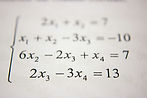
Algebra is genuinely new. Working with pronumerals, expressions and equations is a significant conceptual shift from the arithmetic your child was doing in primary school. Many students can follow along when the teacher works through a problem on the board but struggle to set up problems independently.
Reasoning and working are assessed. In primary school, getting the right answer was usually enough. In Year 7, your child is expected to show their working and explain their thinking. This is a skill that takes time to develop.
Worded problems require more interpretation. Year 7 Maths worded problems ask your child to read a scenario, identify the relevant information and decide which mathematical process to apply. Students who have always been strong at calculations can find this harder than expected.
The students who find Year 7 Maths most difficult are often the ones who did well in primary school without needing to try very hard. The increase in pace and expectations can come as a real surprise. We spend a lot of time at Cloud Tuition helping students understand what the new expectations actually look like." — Cloud Tuition
Will these Year 7 topics be helpful for high school?
All the topics covered in Year 7 Maths are interconnected and foundational for higher-level Maths. For instance, understanding fractions and decimals is essential for tackling algebra, while geometry lays the groundwork for trigonometry and calculus in later years. Data and probability not only help in Maths but are also critical in science and social studies.
When students have a solid understanding of these basics, they’re better equipped to handle the more complex Maths they’ll encounter in the years ahead. That’s why Year 7 is such a crucial year for your child, as it sets the stage for future success.
When to Consider Year 7 Maths Tutoring
If your child is finding Year 7 Maths harder than expected, here are signs it may be time to get support through a private Maths tutor:
They can complete Year 7 Maths worksheets at home but cannot apply the same skills under test conditions
Their test results are lower than expected given their effort
They understood Maths in primary school but are now confused by the same types of problems
They are avoiding Maths homework or becoming anxious about the subject
The same types of mistakes keep appearing across different topics
You do not need to wait until your child is failing. Getting Year 7 Maths tutoring early, even at the start of the year as a proactive step, gives your child the best chance of building strong foundations that carry them through the rest of high school.
The families who reach out early are almost always the ones who see the biggest improvement by the end of the school year. We believe that it's not about whether your child is struggling yet, it's about making sure small gaps in their Maths knowledge or skills do not turn into big ones down the road.
At Cloud Tuition, we match Year 7 students with experienced Maths tutors based on their current topics, learning style and goals. Your child's first lesson is completely free with no payment details required. Book a free Year 7 Maths lesson with Cloud Tuition.
Why consider Maths tutoring for Year 7
Tutoring can be incredibly beneficial for students who are struggling with particular areas or who simply want to stay ahead. A good tutor can tailor lessons to your child’s specific needs, helping them understand concepts they find challenging and reinforcing what they’re learning in school.
🎓 Personalised 1-on-1 learning
One of the biggest advantages of tutoring is the one-on-one personalised approach. In a classroom setting, teachers have to cater to the needs of many students, which means they might not always have the time to focus on the areas where your child needs the most help. On the other hand, an in-person or online Maths tutor can create a customised learning plan that targets your child’s weaknesses and builds on their strengths.
💪 Confidence building
Maths can be a confience killer for some students. When they don’t understand something, they might feel frustrated or even start to think they’re just “bad at Maths.” Tutoring can change that mindset. With the right support, students can build confidence, overcome their fears and even start to enjoy Maths.
For our Year 7 students, we find that they often struggle with understanding how to approach their take-home assignments (e.g. essays, short stories and speeches). During lessons, we focus on making sure that they understand the task and create a plan for how to target objectives in the criteria sheet.
How often should my child have Maths tutoring for Year 7?
For most students, 1-2 sessions per week is enough to keep up with the content and reinforce what they’re learning in school. However, the frequency can be adjusted based on your child’s needs. Some students may benefit from more frequent sessions, especially if they’re preparing for an upcoming test or trying to catch up on material they’ve struggled with.
Our final thoughts
Year 7 Maths is an important year that sets the stage for your child’s future success in high school and beyond. The topics they’ll cover include fractions, decimals, basic algebra, geometry, data and probability. These key topics are foundational concepts that will support their learning in later years of high school. If your child is struggling or you simply want to give them an edge, consider in-person or online tutoring as a way to help them master these essential skills through personalised learning support. With the right Maths help, your child can build the confidence and competence they need to excel in mathematics and enjoy it too!
Book in a free 1-hour trial session with one of our Year 7 Maths tutors
Frequently Asked Questions
What should Year 7 students know in Maths?
By the end of Year 7, your child should be comfortable working with fractions, decimals, percentages, integers (including negative numbers), basic algebraic expressions and equations, area and perimeter of common shapes, volume of rectangular prisms, angle relationships, data interpretation and basic probability. These are the core Year 7 Maths skills outlined in the Australian Curriculum.
What is the hardest topic in Year 7 Maths?
Most Year 7 students find algebra the hardest topic because it is the first time they work with pronumerals and equations formally. Negative numbers, fractions and worded problems are also common areas where students struggle, particularly if their primary school foundations are not fully solid.
What is the Year 7 Maths curriculum in Australia?
The Year 7 Maths curriculum follows the Australian Curriculum and covers six main strands: number, algebra, measurement, space, statistics and probability. States like Queensland, New South Wales and Victoria may align this to their own local curriculum documents, but the core content is consistent nationally.
How can I help my child with Year 7 Maths?
Stay across what topics they are studying, encourage them to ask questions in class and address gaps early before they compound. Year 7 Maths worksheets with worked answers are useful for practice at home. If your child is consistently struggling with a particular area, personalised Year 7 Maths tutoring can help identify and close the gaps.
When should my child start Year 7 Maths tutoring?
As early as possible if the transition from primary school or Year 6 Maths is proving difficult. Many families start tutoring at the beginning of Year 7 to build strong foundations from the start. If your child is already mid-year, getting support now is still far better than waiting until the gaps widen further.
How do I choose a good Maths tutor?
Look for a tutor who has experience teaching Year 7 Maths and who can explain concepts in a way that your child understands. It’s also important to find someone who is patient, encouraging and able to tailor lessons to your child’s needs.
Other related articles:
- 5Page 3