Starting Year 7 is one of the biggest transitions in your child's schooling. Along with a new school, new teachers and new social dynamics, the jump into high school Maths catches a lot of students and families off guard. Topics that felt manageable in Year 6 now appear in a more abstract form, the pace moves faster and expectations around reasoning and working are higher than most primary students are used to.
This guide covers what your child will learn in Year 7 Maths, what tends to be most difficult and how you can support them at home including where to find Year 7 Maths worksheets, revision questions and practice Maths worksheet PDFs.
Cloud Tuition Summary
Cloud Tuition is a Queensland-based online tutoring service offering Year 2-9 English and Maths tutoring, NAPLAN preparation and specialist QCE tutoring in Maths Methods, Biology, Chemistry and other senior subjects.
KEY ARTICLE INSIGHTS:
Year 7 Maths follows the Australian Curriculum across six main areas: number, algebra, measurement, space, statistics and probability
The transition from primary school maths to high school maths is one of the biggest academic shifts your child will make
Worksheets and practice questions are useful revision tools but students also need guidance, feedback and worked examples to genuinely improve
Getting support early in Year 7 makes a significant difference before gaps have a chance to compound
What Does Year 7 Maths Cover in Australia?
Year 7 Maths follows the Australian Curriculum, which is the national framework used across all states and territories. While individual states like Queensland, New South Wales and Victoria may apply their own curriculum documents, the core content is consistent nationally.
The Australian Curriculum organises Year 7 Maths into six content strands:
1️⃣ Number
Integers including negative numbers, fractions, decimals and percentages. Your child will also work with index notation and the order of operations more formally than in primary school.
2️⃣ Algebra
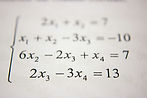
This is where the biggest conceptual shift happens. Your child will be introduced to pronumerals, writing and simplifying expressions, substituting values and solving simple equations. For many students, algebra is the topic that feels most unfamiliar coming from primary school because the thinking required is more abstract.
In Year 5 and Year 6 Maths, algebra was likely presented to your child as a missing number '?', shape or object. In high school algebra, your child will be introduced to variables such as a and x and will be asked to manipulate equations to solve for unknown values.
3️⃣ Measurement
Area and perimeter of shapes including triangles, quadrilaterals and composite figures. Your child will work with units of measurement and begin exploring volume.
4️⃣ Angles & Geometry
Properties of angles including complementary, supplementary and vertically opposite angles. Classification of triangles and quadrilaterals and introduction to transformations.
5️⃣ Statistics
Collecting, organising and interpreting data. Your child will understand how to work with different types of graphs, calculate measures of centre including mean, median and mode and begin to think critically about how data is presented.
6️⃣ Probability
Introduction to probability language and basic probability calculations including equally likely outcomes and simple experiments.
How Is Year 7 Maths Different From Primary School?
Several things change in Year 7 that can surprise students and parents alike.
The pace is faster. High school teachers cover more ground in less time and there is less opportunity to revisit topics once they have been taught.
Working and reasoning matter more. Your child is now expected to show their working, explain their thinking and apply concepts to unfamiliar problems. Getting the right answer without showing how is no longer enough.
Algebra appears formally for the first time. Many students can follow a worked example in class but struggle to set up their own equations independently, particularly if their number foundations are not fully solid.
Worded problems become more demanding. Year 7 Maths worded problems require your child to read carefully, identify the relevant information and decide which mathematical process to apply. Students who have always been strong at Maths sometimes find this harder than expected because it involves reading comprehension as well as mathematical skill.
The students who find Year 7 Maths most difficult are often the ones who did well in primary school without needing to try very hard. The jump in pace and expectations can come as a real shock. We spend a lot of time at Cloud Tuition not just on the content itself but on helping students understand what the new expectations actually look like.
Year 7 Maths Worksheets, Revision and Practice Questions
One of the most practical ways to support your child's Year 7 Maths revision at home is through worksheets and practice questions. Here is what to look for:
Worksheets & revision tests
Rather than a general revision booklet, look for topic-specific practice. Year 7 algebra practice questions, Year 7 mental Maths practice and Year 7 worded problems are all worth targeting separately because they develop different skills. Year 7 maths revision questions are also a great tool if your child has an upcoming test. You'll just have to make sure to ask your child's teacher what content the test will cover and find practice questions that match.
The limitation of worksheets alone
Worksheets give your child practice but they do not explain why an answer is wrong or how to approach a question they are stuck on. If your child can complete straightforward questions but struggles with algebra, worded problems or anything that requires multi-step thinking, they are likely to need more than worksheets to genuinely improve.
We see a lot of Year 7 students who have been doing worksheets at home but are still not improving because nobody has explained where their thinking is going wrong. Practice is valuable but it needs to be paired with feedback and worked examples to address learning gaps. In addition, some teachers expect students to follow the exact steps for solving a problem with clear working out which is something to keep in mind.
What Do Year 7 Students Find Most Difficult?
Based on what we see at Cloud Tuition, the most common sticking points in Year 7 Maths are:
Algebra. The introduction of pronumerals and expressions is the single biggest conceptual jump for most students coming from primary school.
Negative numbers. Operations with integers, particularly multiplying and dividing negative numbers, catches out students who were confident with whole numbers in Year 6.
Fractions and decimals. Students who did not fully consolidate fraction skills in primary school will find these topics more demanding in Year 7, where fractions appear across multiple content areas.
Worded problems. Many students can complete standard procedural questions but struggle to extract the relevant information from a written problem and decide which process to apply.
Mental maths under time pressure. Year 7 mental maths expectations are higher than in primary school and students who have relied on written methods or a calculator may find timed mental maths challenging.
How to Help Your Child With Year 7 Maths at Home
Keep a tab on what they are studying during each term. Ask your school for a term outline or a list of current and upcoming learning objectives and ask your child what topic they are covering each week and whether they feel confident with it. Most students will tell you if something is not making sense, but some need to be asked directly.
Use the Australian Curriculum as a guide.The Australian Curriculum Year 7 Maths topics are publicly available and give you a clear picture of what your child should be learning at each stage of the year. While the exact order of the topics in the Year 7 Maths syllabus differs from school to school, knowing the curriculum helps you understand what your child will need to know so you can spot when they might be falling behind on a particular strand.
Encourage questions in class. High school can feel more intimidating than primary school and some students stop asking for help because they do not want to stand out. Remind your child that asking questions is a sign of engagement, not weakness.
Address learning gaps early. If your child is struggling with algebra in Week 4, do not wait until the end of term to act. Topics in Year 7 Maths build on each other and gaps compound quickly as the year progresses.
When to Get a Year 7 Maths Tutor
There is no single right time, but here are clear signs it may be worth getting support:
Your child says they do not understand what is being taught in class
Their test or assignment results are lower than expected given their effort
They can complete worksheets independently but cannot explain their reasoning when asked
They are avoiding Maths homework or becoming anxious before Maths lessons
The transition from primary school has knocked their confidence in a subject they used to enjoy
You do not need to wait until your child is failing to get support. Many families start Year 7 Maths tutoring at the beginning of the year as a proactive step to make the transition smoother. At Cloud Tuition, we match Year 7 students with experienced Maths tutors based on their current topics, learning style and goals. Your child's first lesson is completely free with no payment details required. Book a free Year 7 Maths lesson with Cloud Tuition.
Frequently Asked Questions
What maths topics are covered in Year 7 in Australia?
Year 7 Maths covers number, algebra, measurement, space, statistics and probability in line with the Australian Curriculum. Key topics include integers, fractions, decimals, percentages, algebraic expressions, equations, area, perimeter, angles, data interpretation and basic probability.
Where can I find free Year 7 maths worksheets?
Free Year 7 maths worksheets and downloadable PDFs with answers are available through a range of educational websites. Look for worksheets that match your child's current topic and include worked solutions so they can check their method, not just their final answer.
Is Year 7 Maths hard?
For many students, Year 7 Maths feels harder than primary school because of the faster pace, higher expectations and the introduction of algebra. The content itself is an extension of what your child has already covered, but the way it is taught and assessed is quite different. With the right support most students adjust well within the first term.
How can I help my child with Year 7 Maths revision at home?
Encourage regular practice using Year 7 maths revision questions and worksheets with worked answers. Focus on the topics your child finds most difficult rather than general revision. If they can complete questions independently but cannot explain their reasoning, or if they are consistently stuck on the same types of problems, personalised tutoring can help identify and close the gaps.
When should my child start Year 7 Maths tutoring?
As early as possible if the transition to high school mathematics is proving difficult. Many families start tutoring at the beginning of Year 7 to build strong foundations from the start. If your child is already mid-year, getting support now is still far better than waiting until the gaps widen further.
Other related articles:
- 5Page 3