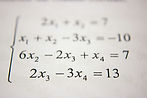
If your child's Maths teacher says they need to work on problem-solving, it does not immediately mean they are bad at Maths. We find that it typically means they are comfortable with practised procedures but find it harder to apply those skills when a question looks unfamiliar or requires more than one step. In other words, they may only lack the practice and awareness of Maths strategies they can use to excel in their school assessment.
Maths problem-solving in Year 7 is important because exam questions that separate an A from a B or C are almost always complex, unfamiliar multi-step problems that require your child to think independently rather than follow a familiar method. The good news is that problem-solving is a skill that can be taught and improved with the right practice and strategies.
Cloud Tuition Summary
Cloud Tuition is a Queensland-based online tutoring service offering Year 2-9 English and Maths tutoring, NAPLAN preparation and specialist QCE tutoring in Maths Methods, Biology, Chemistry and other senior subjects.
KEY ARTICLE INSIGHTS:
Problem-solving in Year 7 Maths goes beyond just calculations. Unlike many areas in primary school Maths, it requires your child to interpret, plan, reason and check
A-level exam questions in Year 7 are almost always multi-step and require problem-solving skills
Your child can be accurate with standard calculations but and still struggle significantly with unfamiliar problems
Building problem-solving skills is one of the most reliable ways to move your child from a C or B to an A in high school Maths
What Problem-Solving Actually Means in Year 7 Maths
There is a difference between knowing how to do something and being able to apply it when the question looks different to what you have practised.
In Year 7 Maths, your child is expected to:
Recall and use: Apply standard procedures accurately in familiar situations (e.g. addition, subtraction, multiplication and division)
Reason: Explain why a method works and whether an answer makes sense (e.g. Explain what went wrong in Mark's calculation)
Problem-solve: Tackle unfamiliar situations by selecting a strategy, combining skills and working through multiple steps independently
Many students are strong at the first skill and weaker at the second and third. This is normal at the start of high school, but it is worth developing because reasoning and problem-solving appear in every Year 7 assessment and make up a significant portion of Year 7 NAPLAN Numeracy.
A Simple Framework: Understand, Represent, Plan, Solve, Check
Teaching your child a consistent process for every problem gives them a starting point even when the question feels unfamiliar.
1) Understand 🧠
Read the full question carefully. Ask your child to explain in their own words what is being asked. If they cannot do this, re-reading before calculating is more useful than starting to work.
2) Represent ✍️
Turn the problem into something visual or structured. A diagram, table, number line, equation or list can make relationships clearer and reduce the chance of missing a step.
3) Plan 🎯
Decide on a strategy before calculating. Which operation is needed? Is this a one-step or multi-step problem? Is there a formula that applies? Estimating an expected range for the answer helps here.
4) Solve 📐
Work through the calculation step by step, showing each stage clearly. For multi-step problems, label each part so the working is easy to follow.
5) Check ✅
Re-read the original question and confirm the answer addresses what was asked. Check units, check reasonableness and check that the answer makes sense in context.
Why Does My Child Struggle Even When They Know the Maths?
Your child can know how to calculate percentages perfectly and still lose marks on a percentage problem-solving question.
This usually happens because:
They rush to calculate before understanding what is being asked
They use every number given in the question even when some are irrelevant
They recognise a keyword and apply an operation without checking whether it fits
They complete the first step but do not know where to go next
They get an answer that does not make sense but do not check it
Maths problem-solving is hard across all year levels and practice is genuinely the thing that builds the skill. What we focus on in our tutoring lessons is helping students develop flexible thinking and the ability to look at an unfamiliar question and find a way in, even if the first approach does not work.
Common Maths Problem Types and Useful Strategies
Problem Type | Example | Useful Strategy |
🔢 Mystery number | A number is multiplied by 4 then 7 is added. The result is 31. Find the number. | Write as an equation: 4x + 7 = 31, solve for x |
📐 Geometry | A triangle has angles in the ratio 1:2:3. Find each angle. | Use angle sum = 180°, write as 1k + 2k + 3k = 180 |
🔁 Number patterns | Find the next three terms: 3, 7, 13, 21, ... and write a rule. | Look at the differences between terms |
💰 Financial Maths | A jacket costs $120 after a 20% discount. What was the original price? | 80% of original = $120, so original = $120 ÷ 0.8 |
📊 Data and statistics | The mean of five numbers is 14. Four of them are 10, 12, 16 and 18. Find the fifth. | Total = 14 × 5 = 70. Fifth number = 70 − 56 = 14 |
🧩 Multi-step measurement | A rectangular pool is 8 m long and 5 m wide. Tiles cost $12 per m². Find the total cost. | Area = 40 m². Cost = 40 × $12 = $480 |
Free Year 7 Maths Problem-Solving Practice Questions with Answers
Try these with your child before looking at the solutions. Encourage them to use the Understand, Represent, Plan, Solve, Check process for each one.
Question 1: I think of a number, double it and subtract 9. The answer is 15. What is the number?
Question 2: The angles in a triangle are in the ratio 2:3:5. Find each angle.
Question 3: A sequence starts: 5, 9, 13, 17, ... What is the 10th term?
Question 4: A rectangle has a perimeter of 42 cm. Its length is twice its width. Find the area of the rectangle.
Question 5: Three friends split a restaurant bill equally. After a 10% discount, the total was $81. How much did each person pay?
Question 6: In a class of 30 students, 2/5 play a sport and half of those also play a musical instrument. How many students play both?
Question 7: A shop sells apples for $0.85 each and oranges for $1.20 each. Max buys 4 apples and 3 oranges and pays with a $10 note. How much change does he receive?
Question 8: The mean of four numbers is 18. Three of the numbers are 14, 21 and 20. What is the fourth number?
Common Year 7 Maths Problem-Solving Mistakes to Watch For
1) Using every number in the question
Some questions include extra information that is not needed. Encourage your child to ask whether each number is actually relevant before using it.
2) Relying too heavily on keywords
Keywords like "total" or "difference" are useful hints but not reliable rules. The full context of the question always takes priority.
3) Stopping after the first step
Multi-step problems require your child to use the answer from one step as the starting point for the next. A common error is treating the intermediate answer as the final answer.
4) Not checking whether the answer makes sense
An answer of 450 cm² for a small rectangle or a probability of 1.8 should both trigger a recheck. Estimation before solving gives your child a reference point for this.
How Do I Help My Child With Maths Problem-Solving at Home?
The most effective way to support your child is to ask guiding questions rather than showing them what to do.
Some useful prompts:
What do you know from the question?
What are you trying to find?
Have you drawn a diagram or written down what you know?
Does your answer seem reasonable?
What did you try first? Did it work?
Letting your child sit with a difficult question for a few minutes before stepping in is genuinely useful. The ability to persist through unfamiliar problems is a skill in itself and one that develops with practice.
When to Get Extra Year 7 Maths Tutoring Support
If your child understands individual Maths topics but consistently loses marks on multi-step or problem-solving questions, that skill gap is worth addressing directly. More of the same standard practice will not build problem-solving skills. What helps is working through unfamiliar questions with someone who can guide the thinking process and help your child develop independence.
At Cloud Tuition, our Maths tutoring sessions for Year 7 students focus on developing the flexible thinking and reasoning skills that move students from completing standard questions to tackling the harder problems that carry the most marks. Your child's first lesson is completely free with no payment details required. Book a free lesson with a Year 7 Maths tutor.
Frequently Asked Questions
What should a Year 7 student be able to do in Maths?
By the end of Year 7, your child should be able to apply skills across number, algebra, measurement, geometry, statistics and probability to solve both familiar and unfamiliar problems. They should be able to show their working clearly, explain their reasoning and check whether an answer makes sense in context. Problem-solving and mathematical reasoning are assessed alongside calculation accuracy in Year 7.
How can I improve my child's problem-solving skills in Maths?
Encourage your child to read questions fully before starting, represent problems visually using diagrams or tables and break multi-step problems into smaller parts. Ask guiding questions rather than showing them the answer. Reviewing incorrect questions and identifying where the reasoning went wrong is more effective than repeating more questions of the same type.
Do problem-solving questions appear in Year 7 NAPLAN?
Yes. Year 7 NAPLAN Numeracy includes a significant proportion of applied and multi-step questions that require your child to interpret a scenario, select a strategy and show reasoning. These are the questions most students find hardest and they are also the ones where targeted preparation makes the biggest difference.
What are five problem-solving strategies for Year 7 Maths?
Draw a diagram, write an equation, make a table or list, work backwards from the answer and break the problem into smaller steps. No single strategy works for every problem. Helping your child become comfortable with several approaches and choosing between them is what builds genuine problem-solving flexibility.
Why does my child understand the Maths but struggle with problem-solving questions?
Because applying a skill in an unfamiliar context is a separate skill to knowing it in isolation. Your child may be able to calculate a percentage perfectly when the question says "find 20% of $80" but struggle when the same calculation is embedded in a multi-step financial scenario. This is very common in Year 7 and improves significantly with targeted practice on applied and reasoning questions.
Solutions
Q1: 2x − 9 = 15. 2x = 24. x = 12
Q2: 2k + 3k + 5k = 180. 10k = 180. k = 18. Angles: 36°, 54° and 90°
Q3: Pattern increases by 4 each time. Formula: 5 + (n−1) × 4. 10th term = 5 + 36 = 41
Q4: Let width = w, length = 2w. Perimeter: 2(w + 2w) = 42. 6w = 42. w = 7 cm, length = 14 cm. Area = 7 × 14 = 98 cm²
Q5: After 10% discount, $81 is 90% of the original. Original = $81 ÷ 0.9 = $90. Per person = $90 ÷ 3 = $30
Q6: 2/5 of 30 = 12 play sport. Half of 12 = 6 play both
Q7: 4 × $0.85 = $3.40. 3 × $1.20 = $3.60. Total = $7.00. Change = $10 − $7 = $3.00
Q8: Total = 18 × 4 = 72. Sum of three = 14 + 21 + 20 = 55. Fourth number = 72 − 55 = 17
Other related articles:
- 5Page 3