If your child has just started high school or is about to, knowing what they are actually learning in Year 7 Maths makes it much easier to support them at home. The Australian Curriculum covers a lot of ground in high school maths and some of the topics will look very different from what your child was doing in primary school maths.
Here is an easy breakdown of every major topic area in Year 7 Mathematics so you know what to expect for your child, especially if they're transitioning from Year 6.
Cloud Tuition Summary
Cloud Tuition is a Queensland-based online tutoring service offering Year 2-9 English and Maths tutoring, NAPLAN preparation and specialist QCE tutoring in Maths Methods, Biology, Chemistry and other senior subjects.
KEY ARTICLE INSIGHTS:
Year 7 Maths follows the Australian Curriculum and covers six main strands: number, algebra, measurement, space, statistics and probability
Algebra is the biggest new concept most students encounter in Year 7 and the one that causes the most confusion
Understanding what your child is learning helps you spot when they are falling behind before the gaps get bigger
If your child can follow worked examples but cannot set up problems independently, they may need more targeted support which they can get with online Maths tutoring
🔢 Numbers
Numbers are the foundation of everything in Year 7 Maths. Your child will work with integers including negative numbers, which is often the first time they encounter numbers below zero in a formal way. They will also deepen their skills with fractions, decimals and percentages, converting between different forms and using all four operations.
Other key areas include:
Representing natural numbers as products of prime factors using exponent notation (e.g. writing 24 as 2³ × 3)
Understanding squares of numbers and square roots of perfect squares
Working with ratios in practical contexts (e.g. 'best buy' situations comparing Brand A which costs $1.20/L to Brand B which costs 65c/500mL)
Rounding decimals appropriately and checking answers for reasonableness (e.g. 1.9 people is no a reasonable answer and needs rounding)
If your child's fraction skills are not fully solid from Year 5 and Year 6 Maths, this is where it will show. Fractions appear across multiple topics in Year 7 and any gaps from earlier years will make things harder.
✖️ Algebra
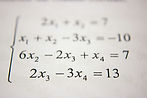
Algebra is the single biggest conceptual shift in Year 7 Maths and often the most difficult topic for most high school students. Your child will move from working purely with numbers to using letters like 'x' (called pronumerals) to represent unknown values.
What this looks like in practice:
Writing and simplifying algebraic expressions using constants, variables, operations and brackets
Substituting values into formulas to find unknown quantities
Solving simple linear equations with natural number solutions (for example, solving 2x + 5 = 15)
Creating tables of values from expressions and plotting linear relationships on a Cartesian plane
Describing how changes in one variable affect another
Algebra is where we see the most Year 7 students hit a wall. They can follow along when the teacher does it on the board but freeze when they have to set up a problem themselves. We find that most students aren't clear on how to break down algebra questions on their own, likely because their class moves too quickly or they haven't caught up on homework practice.
📐 Measurement
In Year 7, measurement goes beyond basic length and area calculations.
Your child will:
Use formulas to calculate the area of 2D shapes like rectangles, triangles and parallelograms
Calculate the volume of rectangular and triangular prisms
Describe the relationship between the radius, diameter and circumference of a circle (including the role of pi)
Work with appropriate units and convert between them
This strand connects closely to algebra because students need to substitute values into measurement formulas, which reinforces their algebraic skills in a practical context.
🟧 Space (Geometry)
Space in Year 7 covers both two-dimensional and three-dimensional reasoning.
This includes learning objectives such as:
Identifying angle relationships including complementary, supplementary, alternate and co-interior angles formed when parallel lines are crossed by a transversal
Demonstrating that the interior angle sum of a triangle is 180 degrees and applying this to other shapes
Classifying triangles, quadrilaterals and other polygons according to their properties
Describing transformations including translations, reflections and rotations using coordinates on the Cartesian plane
Representing 3D objects in two dimensions
📊 Statistics
Your child will move beyond simple graphs into more formal data analysis.
Things they will cover in Year 7 statistics:
Planning and conducting statistical investigations using both discrete and continuous data
Calculating the range, mean, median and mode of data sets
Creating data displays including stem-and-leaf plots
Interpreting the shape of data distributions, understanding skewness and identifying outliers
Deciding which measure of central tendency is most useful for a given data set (e.g. median, mode or mean and their pros and cons)
🎲 Probability
Year 7 probability introduces the language and calculations that will carry through to senior Maths, even all the way up to Year 12.
Learning objectives in probability include:
Identifying sample spaces for single-step experiments
Assigning probabilities to outcomes and understanding that probabilities sum to 1 for a given experiment
Differentiating probability from frequency
Predicting relative frequencies
Conducting repeated experiments and comparing predicted results with observed results
Explaining differences between expected and actual outcomes
What If Your Child Is Struggling With a Particular Year 7 Maths Topic?
If your child is finding one or more of these areas difficult, the most important thing is to identify it early. Year 7 Maths topics build on each other and a gap in algebra in Term 1 can make measurement and statistics harder later in the year.
At Cloud Tuition, we match Year 7 students with experienced Maths tutors who can identify exactly where your child's understanding is breaking down and work with them at their own pace. Your child's first lesson is completely free with no payment details required. Book a free Year 7 Maths lesson with Cloud Tuition.
Frequently Asked Questions
What are the main Year 7 Maths topics in Australia?
The Australian Curriculum Year 7 Maths syllabus covers six main areas: number, algebra, measurement, space, statistics and probability. Key skills include working with fractions, decimals and percentages, solving simple equations, understanding integers, calculating area and volume, interpreting data and conducting basic probability experiments.
Which Year 7 Maths topic do students find hardest?
Most students find Year 7 algebra the most challenging because it is the first time they work with pronumerals and equations formally. Year 7 worded problems are also a common difficulty because they require reading comprehension as well as mathematical skill.
Is a Year 7 Maths textbook enough for revision?
A Year 7 Maths textbook is definitely a useful reference but more often than not, it is not always enough on its own. Year 7 Maths textbook questions tend to follow predictable formats, which means your child might be able to complete them at home but struggle when the same concepts appear in a different context under test conditions. Supplementing with in-person or online tutoring with a strong focus on how to apply correct techniques and how to break down multi-step questions and worded problems will give your child a broader range of practice for exam revision.
How can I help my child with Year 7 Maths at home?
We recommend following along with the Year 7 Maths curriculum and checking on on what your child is learning at school week by week. Ask your child's school for a term outline or list of upcoming learning objectives as well as any information about their upcoming Maths assessment or exam. From there, use targeted worksheets, PDFs or practice tests to help them revise for the concepts that they cover at school.
Where can I find Year 7 Maths worksheets with answers for each topic?
Free Year 7 Maths worksheets and PDFs are available through a range of educational websites. Look for worksheets that match the specific Australian Curriculum Year 7 Maths topics your child is currently covering.
Other related articles:
- 5Page 3